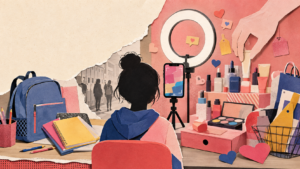
How TikTok GRWM Videos Commercialize Childhood
According to the research presented in “Get Ready With Me for School”: Childhood and Adolescence Commercialization Through Branded Beauty Videos on TikTok, TikTok GRWM videos and childhood commercialization are closely connected through beauty routines that merge personal storytelling, product display, family participation, and platform visibility.
This article explains how apparently ordinary “Get Ready With Me” videos can function simultaneously as entertainment, identity performance, consumer education, and promotional communication.
The main findings indicate that videos coded as organic promotion generated more engagement than explicitly disclosed advertising. The study also found that adult participation was associated with more promotional product displays, challenging the assumption that parental presence in children’s digital content is always primarily protective.
What is a GRWM video?
A Get Ready With Me, or GRWM, video shows a creator preparing for school, an event, bedtime, or another everyday activity. The creator commonly applies skincare or makeup products while talking about personal experiences, school, relationships, plans, or emotions.
The format feels intimate because viewers follow the routine step by step. Products are not necessarily presented as conventional advertisements. Instead, they appear as normal components of the creator’s life.
In videos featuring children and adolescents, GRWM content may include:
- Cleansing and moisturizing routines
- Sunscreen application
- Makeup tutorials
- Skincare recommendations
- Beauty-product hauls
- Morning or nighttime routines
- Personal stories combined with brand mentions
This combination makes GRWM beauty content on TikTok commercially significant. It teaches viewers not only which products exist but also how products can be integrated into identity, belonging, maturity, and everyday life.
Why is it important?
Children and adolescents are not merely watching beauty content. They are increasingly participating in its production, learning how to present products, attract attention, imitate influencers, and construct commercially recognizable online identities.
According to the research, TikTok’s likes, comments, favorites, and shares do more than measure popularity. These metrics create incentives for continuous visibility and reward content that appears authentic, relatable, and native to the platform.
A beauty routine can therefore perform several functions at once:
- Personal self-expression
- Social interaction
- Entertainment
- Product instruction
- Brand promotion
- Audience building
- Preparation for possible monetization
The boundary between play and commercial labor becomes difficult to identify, particularly when sponsorship is not clearly disclosed.
How was the study conducted?
The researchers used an exploratory mixed-methods design combining quantitative engagement analysis with qualitative thematic interpretation.
The final sample consisted of 198 public TikTok videos featuring children or adolescents interacting with identifiable beauty products and brands.
A preliminary pilot study of 25 videos was conducted between September and October 2024 to refine the analytical codebook. Those pilot videos were not included in the final sample. The main dataset was collected between November 2024 and January 2025.
Videos were located through hashtags that included:
- #skincareforkids
- #sephorakids
- #childskincare
- #kidsgrwm
- #childmakeup
- #grwmforschool
A new TikTok account with no previous interaction history was used to reduce the influence of personalized recommendations. The researchers did not like, follow, share, or comment on the videos during collection.
What did the researchers measure?
The quantitative analysis examined:
- Likes
- Comments
- Favorites
- Shares
- Paid versus organic promotion
- Performer configurations
- Adult participation
- Product-display formats
The qualitative analysis examined:
- Beauty routines
- Brand references
- Personal narratives
- Family interactions
- Identity formation
- Aspirational labor
- Negotiations of childhood and adolescence
Grounded theory techniques were used to identify recurring narratives and connect them with broader concepts such as consumer socialization, self-branding, parental mediation, and commercial visibility.
What does “organic promotion” mean in this study?
The researchers divided the videos into two promotional categories.
Paid advertising
Content was coded as paid advertising when it contained an explicit indicator of a commercial relationship, such as:
- A sponsorship statement
- A verbal acknowledgement of collaboration
- #ad
- #sponsor
- A comparable disclosure marker
Organic promotion
Content was coded as organic when products were displayed or discussed without an explicit sponsorship acknowledgement.
This distinction requires caution. “Organic” does not necessarily mean that a video had no commercial value or brand influence. It means that the researchers could not identify an explicit paid partnership from the available content.
The difficulty of distinguishing paid from organic material is itself one of the study’s central findings. TikTok promotions frequently use subtle product placement, casual recommendations, and routine-based storytelling that do not resemble traditional advertisements.
Organic beauty content generated more engagement
Organic promotion dominated the dataset:
- 92.4% of videos were coded as organic promotion.
- 7.6% were coded as paid advertising.
Videos containing organic promotion received significantly greater total engagement than explicitly paid advertisements.
Total engagement was calculated by adding likes, comments, favorites, and shares. Organic videos had a mean rank of 102.33, compared with 65.03 for paid advertisements. The Mann–Whitney test found a statistically significant difference: U = 855.5, Z = −2.468, p = .014.
The main findings indicate that audiences interacted more with content that appeared spontaneous or integrated into ordinary life than with posts clearly identified as commercial.
This association does not prove that advertising disclosure directly caused lower engagement. Other differences between the videos may have influenced audience behavior. Nevertheless, the pattern supports the researchers’ concept of a disclosure penalty.
What is the disclosure penalty?
The disclosure penalty describes the lower engagement associated with overtly disclosed advertising compared with apparently organic product content.
When viewers recognize a post as an advertisement, their awareness of persuasive intent may increase. The creator can be perceived as less spontaneous, less impartial, or less authentic.
By contrast, a product embedded in a school-morning routine may appear to be a sincere personal choice, even when it produces considerable promotional value.
According to the research, this creates a problematic incentive within influencer culture:
- Explicit advertising receives less interaction.
- Organic-looking routines receive greater engagement.
- Engagement metrics improve content visibility.
- Creators and brands may therefore favor less recognizable promotional formats.
This does not mean that the studied creators deliberately concealed sponsorships. The analysis could not verify undisclosed commercial relationships. It instead shows that the platform environment may reward commercially useful authenticity.
Which interactions were most common?
Among videos classified as organic promotion, engagement followed a clear hierarchy:
| Interaction | Mean rank |
|---|---|
| Likes | 3.74 |
| Favorites | 2.52 |
| Shares | 1.90 |
| Comments | 1.84 |
Likes were the most prominent form of interaction. They require relatively little effort and provide immediate signals of approval and visibility.
Favorites were second, suggesting that many viewers saved beauty routines for later reference. Shares and comments required more active participation and were less common.
The differences across the four engagement types were statistically significant, χ² = 386.727, df = 3, p < .001.
Who appeared in the videos?
Children and adolescents appeared in several configurations:
- Alone
- Alongside adult family members or caregivers
- Alongside young adults
- In intergenerational beauty routines
Videos featuring children or adolescents with adults represented 47.5% of the sample, making this the largest performer configuration.
Adolescents appearing alone accounted for 39.4% of all videos. Although organic formats dominated this category, adolescents were also prominently represented in explicitly paid content.
Videos involving younger adult companions were uncommon and appeared exclusively in the organic category.
These results show that youth beauty content on TikTok is frequently a family-mediated practice rather than an entirely individual activity.
How did adults participate?
Adult involvement took several forms:
| Form of adult participation | Percentage |
|---|---|
| No adult present | 47.5% |
| Adult encouraged or promoted the activity | 33.8% |
| Active supervision or collaboration | 19.2% |
Almost half of the videos showed no visible adult involvement. In other cases, adults encouraged the routine, asked questions, selected products, filmed the content, participated in the activity, or helped structure the presentation.
Adults sometimes acted as:
- Supervisors
- Collaborators
- Camera operators
- Interviewers
- Product selectors
- Beauty-routine participants
- Sources of encouragement
- Promoters of the activity
The presence of an adult therefore did not have one uniform meaning. It could represent care and guidance, but it could also strengthen the promotional organization of the video.
What is parental promotional mediation?
The study introduces parental promotional mediation to describe situations in which adult involvement helps structure a child’s or adolescent’s branded content.
Traditional parental mediation is often discussed as a protective practice. Parents may restrict access, discuss risks, supervise media use, or help children interpret content.
Parental promotional mediation adds a different possibility: adults may contribute to the visibility and commercial clarity of branded performances by:
- Directing the routine
- Highlighting products
- Asking the child to explain purchases
- Organizing the narrative
- Participating in product demonstrations
- Creating family-oriented promotional scenes
- Making brand integration appear natural within domestic life
The concept does not imply that every participating parent is pursuing commercial gain. It shows that adult co-presence can function as promotional infrastructure, regardless of the adult’s intention.
Adult participation was linked to product-display style
The researchers identified three consolidated product-display categories:
- Usage demonstrations
- Promotional displays
- Other evaluative displays
Their distribution was:
| Product-display format | Videos | Percentage |
|---|---|---|
| Usage demonstrations, including GRWM | 140 | 70.7% |
| Recommendations and product placements | 46 | 23.2% |
| Reviews, comparisons, and brand experiences | 12 | 6.1% |
A statistically significant association was found between adult participation and display type: χ²(4) = 13.440, p = .009. The effect size was moderate, with Cramer’s V = .184.
Videos with actively involved adults contained more promotional displays than expected. By contrast, videos without adults disproportionately featured usage demonstrations.
Among videos with no adult present:
- 81.7% were usage demonstrations.
- 14% were promotional displays.
- 4.3% were other evaluative displays.
Among videos in which adults encouraged or promoted the activity:
- 56.7% were usage demonstrations.
- 32.8% were promotional displays.
- 10.4% were other displays.
The main findings indicate that adult participation can make product presentation more direct and commercially legible.
How do GRWM videos teach consumption?
A conventional advertisement tells viewers that they should consider buying a product. A GRWM video shows how that product fits into a desirable life.
The creator may connect a moisturizer, serum, or makeup product with:
- Getting ready for the first day of school
- Becoming more confident
- Developing a mature identity
- Looking prepared and competent
- Participating in a trend
- Belonging to a peer group
- Becoming an influencer
- Practising self-care
This process can be understood as brand pedagogy. Viewers learn product names, application sequences, aesthetic preferences, and consumption habits through repeated observation.
The routine makes promotion feel instructional and personal rather than explicitly persuasive.
The four principal themes
The qualitative analysis identified four interconnected themes:
- Identity formation through personal-care rituals
- Aspirational labor and brand symbolism
- Family mediation and intergenerational beauty bonds
- Negotiation of childhood and adolescence through beauty culture
The conceptual diagram on page 20 connects identity formation, family mediation, and aspirational labor with the broader commercialization of childhood and adolescence.
Identity formation through beauty routines
Personal-care rituals formed the thematic center of the videos.
Children and adolescents did not merely display products. They used routines to narrate who they were, who they wanted to become, and how they wished to be perceived.
The illustrated example on page 21 depicts a school-morning GRWM video in which personal excitement about beginning school is combined with product use and beauty recommendations.
For younger children, routines frequently emphasized:
- Cleansing
- Moisturizing
- Sunscreen
- Basic hygiene
- Products described as gentle or suitable for young users
Frequently visible brands included Bubble, Evereden, and CeraVe.
Among adolescents, routines became more complex and expressive. Creators discussed serums, exfoliants, makeup techniques, ingredients, and product benefits. Brands included:
- The Ordinary
- Glow Recipe
- Drunk Elephant
- Rare Beauty
- e.l.f.
These brand examples are descriptive findings from the dataset, not endorsements or confirmations that every product is suitable for minors.
Aspirational labor and self-branding
Aspirational labor refers to creative work performed in pursuit of possible future visibility, status, opportunity, or income.
Children and adolescents imitated recognizable influencer practices by:
- Maintaining curated beauty routines
- Producing hauls
- Discussing purchasing strategies
- Presenting product expertise
- Developing a consistent persona
- Balancing expensive and affordable products
- Addressing viewers as an audience
- Creating content that could attract brands
The illustration on page 23 shows a young creator displaying a collection of skincare products while naming products and stores.
Such videos reveal that the labor extends beyond applying products. It also includes researching, saving money, selecting, arranging, filming, narrating, editing, and presenting purchases.
Luxury and affordable brands were sometimes combined in the same narrative. This allowed creators to display aspiration while remaining relatable to viewers with different budgets.
Family mediation and beauty bonds
Family involvement sometimes transformed beauty routines into moments of bonding, teaching, and emotional support.
Parents helped children select products described as age appropriate, assisted with application, or used routines as opportunities for conversation.
The study describes examples such as:
- A mother guiding an eight-year-old during a visit to Sephora
- A father joking about his daughter’s large Bubble collection
- A mother and daughter comparing nighttime skincare routines
- A mother doing her daughter’s hair while the child discussed school and used beauty products
The illustration on page 25 presents a parent commenting on a child’s extensive skincare collection.
These scenes show that family participation can have dual effects. It may provide supervision and emotional connection while simultaneously normalizing brands within domestic relationships.
Negotiating childhood and adolescence
The Sephora Kids phenomenon appeared as a recurring point of tension.
Some pre-adolescents performed sophisticated beauty routines while criticizing younger children for participating in similar practices. The illustration on page 26 depicts a young creator expressing frustration about nine-year-olds purchasing products at Sephora.
This contradiction shows how beauty consumption can become a way of defining maturity:
- “I am old enough to understand these products.”
- “Younger children are not ready.”
- “Product expertise demonstrates maturity.”
- “Advanced routines separate adolescents from children.”
Yet the criteria for maturity are themselves shaped by consumer culture. Ownership, expertise, and aesthetic performance become markers of growing up.
Does skincare content empower young creators?
The answer is complex.
Beauty content can support creativity, communication, technical learning, self-expression, and social connection. Children and adolescents may experience genuine enjoyment and agency while producing it.
However, the study warns that empowerment narratives can conceal commercial pressures.
A routine framed as confidence or self-care may also teach young people that:
- Identity requires continual product consumption.
- Visibility depends on appearance.
- Personal value can be measured through engagement.
- Everyday life should be converted into content.
- The self should be presented as a commercially attractive brand.
The researchers therefore avoid reducing the phenomenon to either complete exploitation or complete empowerment. Youth agency exists, but it operates within platform and market structures that shape which performances receive attention.
How is it applied?
For parents
Parents should look beyond explicit sponsorship labels and discuss how products gain promotional value inside apparently ordinary routines.
Useful questions include:
- Why is this product visible?
- Does the routine require so many steps?
- Is the product suitable for the creator’s age?
- Is the recommendation based on expertise or popularity?
- Could the video still function as advertising without an #ad label?
- Who benefits when the video receives more engagement?
Parental participation should preserve the child’s privacy, agency, health, and right to refuse or withdraw.
For educators
Advertising literacy education should address more than conventional commercials.
Students need tools for recognizing:
- Routine-based promotion
- Product placement
- Influencer authenticity techniques
- Parasocial trust
- Algorithmic incentives
- Emotional storytelling attached to brands
- The difference between popularity and expertise
- The commercial value of likes and shares
A child may correctly identify a sponsored post and still fail to recognize the promotional influence of repeated, undisclosed product exposure.
For beauty brands and agencies
The findings suggest that formal compliance with disclosure rules is not sufficient when minors are involved.
More responsible practices would include:
- Strict age thresholds for collaborations
- Clear and prominent disclosure
- Independent evaluation of product suitability
- Limits on using family intimacy as a sales technique
- Protection of minors’ earnings and data
- Meaningful consent and withdrawal procedures
- Avoidance of products or routines unsuitable for young skin
- Clear distinctions between education and endorsement
High engagement should not automatically be treated as evidence that a campaign is socially responsible.
For TikTok and other platforms
Platforms could strengthen protections through:
- More visible advertising disclosures
- Detection of repeated undeclared brand promotion
- Limits on targeted beauty advertising to minors
- Greater transparency around monetization
- Child-centered recommendation safeguards
- Reduced amplification of potentially unsuitable routines
- Accessible reporting mechanisms
- Controls over the commercial use of children’s images and identities
The research argues that governance should examine not only individual sponsored posts but also cumulative exposure to brands and the recommendation systems that amplify commercially recognizable youth content.
For regulators
Disclosure-focused regulation may overlook content whose persuasive force comes from repetition, intimacy, and apparently spontaneous product use.
The study recommends broader attention to:
- Cumulative brand exposure
- Monetization involving minors
- Family-mediated promotion
- Children’s labor and compensation
- Product safety and age appropriateness
- Algorithmic amplification
- Commercial use of domestic life
- The long-term preservation of children’s digital identities
Ethical approach used in the study
The researchers analyzed publicly available videos and adopted privacy protections because the content involved minors.
Identifying details were not reproduced in the study’s visual materials. Instead, the authors created anonymized representations based on the videos while preserving relevant brand references and narrative characteristics.
The images on pages 21, 23, 25, and 26 are therefore reconstructed research illustrations rather than screenshots that reveal the identities of the original children.
This approach allowed the researchers to discuss visual and narrative patterns while reducing the risk of further circulating identifiable images of minors.
Limitations of the research
Several limitations affect how the findings should be interpreted.
First, the sample included only public videos collected during a three-month period. Private, deleted, temporary, restricted, or less algorithmically visible content was not available for analysis.
Second, the sample was purposive rather than statistically representative of all TikTok beauty videos. The reported percentages describe the 198 analyzed videos and should not be generalized to the entire platform.
Third, distinguishing organic from paid promotion remained difficult. Product placement and commercial relationships may not be disclosed clearly, meaning that some videos could have been classified differently if additional information had been available.
Fourth, children’s and adolescents’ ages were inferred from contextual information such as self-descriptions, school references, and accompanying adults rather than independently verified.
Fifth, content analysis can identify visible patterns but cannot reveal how creators, parents, or audiences understood their own participation.
Finally, the study found associations rather than causal effects. It cannot prove that adult participation caused promotional displays or that disclosure itself caused lower engagement.
What are the main conclusions?
According to the research, TikTok GRWM videos and childhood commercialization intersect through a digital environment in which beauty, intimacy, identity, and advertising become difficult to separate.
The main findings indicate that:
- Organic-looking promotion was much more common than explicitly paid advertising.
- Organic content received higher total engagement.
- Likes were the dominant interaction.
- GRWM usage demonstrations represented 70.7% of the videos.
- Adults appeared frequently and were associated with more promotional displays.
- Beauty routines helped young creators perform identity and maturity.
- Brand knowledge became a form of social and symbolic competence.
- Family relationships could provide care while also increasing commercial visibility.
- Childhood and adolescence were increasingly presented as marketable identities.
This article explains why the principal concern is not simply whether children use beauty products or appear on TikTok. The deeper issue is how platform incentives encourage young people to translate ordinary life, relationships, and developing identities into commercially valuable performances.
Frequently asked questions
What does GRWM mean?
GRWM means Get Ready With Me. It describes videos in which creators show their preparation routine while speaking to viewers.
Are all GRWM videos advertisements?
No. Some contain explicitly disclosed sponsorships, while others show products without acknowledging a commercial relationship. Even non-sponsored content can generate promotional value for brands.
What is the disclosure penalty?
The disclosure penalty is the study’s term for the lower engagement observed in explicitly paid advertisements compared with apparently organic promotional videos.
Did organic videos receive more engagement?
Yes. Videos coded as organic promotion had significantly higher total engagement than posts identified as paid advertisements.
What percentage of videos were explicitly paid?
Paid advertisements accounted for 7.6% of the sample. The other 92.4% were coded as organic promotion.
What was the most common product-display format?
Usage demonstrations, particularly GRWM routines and tutorials, were the most common format and represented 70.7% of the videos.
Did parents reduce commercialization?
Not necessarily. Adult participation could provide supervision and support, but it was also associated with more direct promotional product displays.
What is parental promotional mediation?
It describes adult participation that helps organize, frame, or strengthen the promotional presentation of products in content featuring minors.
Which brands appeared in the study?
Examples included Bubble, Evereden, CeraVe, Rare Beauty, e.l.f., The Ordinary, Glow Recipe, and Drunk Elephant.
Does the study prove that TikTok harms children?
No. It identifies commercial, cultural, and ethical patterns in a sample of public videos. It does not directly measure psychological or physical harm to individual creators or viewers.
What should advertising-literacy programs teach?
They should teach young people to recognize emotional storytelling, product placement, routine-based promotion, algorithmic incentives, and family-mediated advertising—not only explicit sponsorship labels.
What is the central takeaway?
A seemingly informal beauty routine can act as a powerful form of consumer socialization, teaching children and adolescents to connect products with confidence, maturity, belonging, visibility, and personal identity.